It’s All Just the Cloud: The Appeal and the Limits of the Cloud
What the cloud really adds to classic hosting, why Pizza as a Service explains IaaS and PaaS best, and why some companies move back out.
 by Adriaan WindPortion: 4 min

On the menu (table of contents)
This post first appeared in German on the digitalHUB Aachen blog in October 2022. Four years later, the follow-up: Building Beyond Hyperscalers in European Clouds.
The cloud adds flexibility and managed services on top of classic hosting. That pays off at the start, while you stay in the free tiers, and when you really need to scale. Provider-specific services lock you in, and at steady load the bill grows faster than the benefit.
The cloud, the final frontier. At least that’s what the cloud providers promise us these days. The limits depend on how much you are willing to pay. Over the last few years, the cloud has become more and more popular, and many companies have moved into it. But is cloud computing really the solution to every problem, and is it right for everyone?
Not every cloud is the same
We all know the line “the cloud is just someone else’s computer”. But if all we get in the cloud is servers, how is it different from the classic hosting offers that have been around for decades? Simple: the cloud offers a lot more. Not just servers, but services, and one more important thing: flexibility.
To understand what the cloud adds, we need to take a few steps back. Companies have always needed servers, and more than one of them has a server room in the basement. That’s on-premises: everything runs on your own premises. You take care of power, cooling and security, and you buy the hardware yourself.
What the cloud has to do with pizza
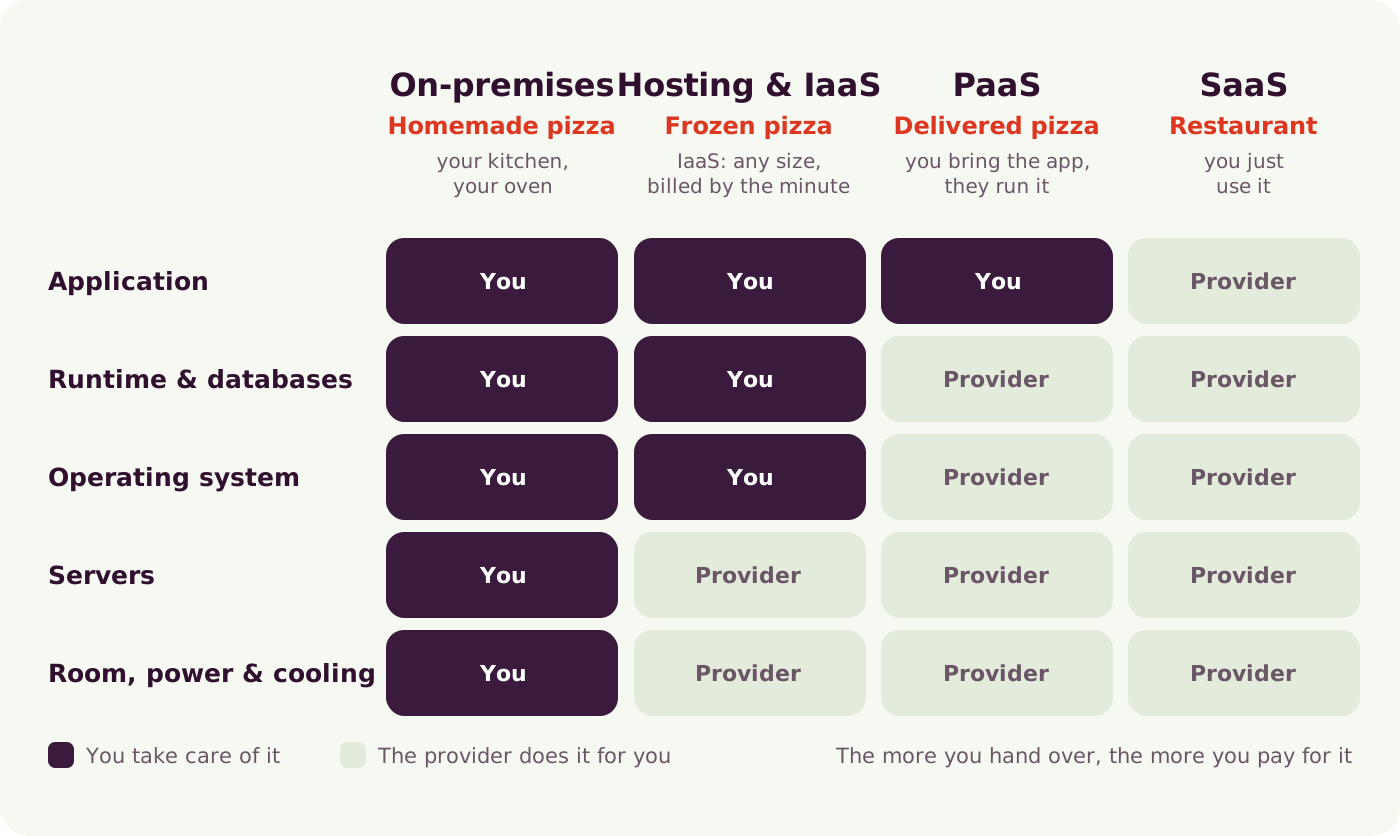
To make this easier to follow, people like to reach for a pizza analogy. An on-premises setup is baking pizza at home: we use our own kitchen, provide the energy and the oven, make our own dough, take care of the toppings, put it all together and eat it at home. The upside: we decide exactly which ingredients go into the dough and which toppings go on the pizza.
Hosting
With hosting, it gets simpler. You don’t take care of the infrastructure, and you don’t buy or maintain the server hardware: the provider does that. You rent the server for a fixed period.
Back to the pizza: this is a frozen pizza. It’s almost done, we only put it in the oven, finish baking it and eat. But we can only choose from a few predefined varieties.
Infrastructure as a Service (IaaS)
The cloud has the same principle. It’s called Infrastructure as a Service (IaaS), and what sets it apart from classic hosting is mostly flexibility.
At a classic hoster, we choose between fixed combinations of CPU and memory. In the cloud, we set both in fine steps, exactly as we need them. The same goes for terms: a classic hoster usually rents for fixed terms, from one month to several years. In the cloud, you can cancel at any time, and you pay by the minute.
Platform as a Service (PaaS)
Now to where the cloud really shines: Platform as a Service (PaaS). Here we take care of even less. Roughly speaking: we hand over the application, exactly the thing that should run in the cloud, and the provider makes sure it runs. We don’t manage databases either, we book them as managed services. That saves us a lot of admin work, and of course we pay for it.
In pizza terms: we order a pizza, it gets delivered, and all that’s left is eating it at home.
To finish the analogy, the last step is eating the pizza in a restaurant instead of at home. There you don’t take care of anything at all. That’s Software as a Service (SaaS): a finished product you simply buy.
The power of PaaS
PaaS is the big advantage of the cloud, because the provider takes over a lot of the management. But there is more behind it. In software development, it has become normal to pack an application into containers. Each container is self-contained and brings every dependency it needs, and a container runtime runs them.
Who would have guessed: cloud providers offer this runtime as a service too, for example as Kubernetes. All you need are your containers and the manifests that configure Kubernetes. Need a database as well? No problem: a few clicks and a few minutes later, it runs on hardware built for exactly that, without a database administrator.
One step further: maybe we don’t want to deal with building containers at all. We have a finished application, and it should run in the cloud. The providers have a ready-made answer for that too, for example App Engine on Google Cloud.
We quickly notice that the cloud can take more and more work off our hands, especially for management, flexibility and scaling. But we haven’t reached the top level yet: services that only exist at one provider. With AWS Cognito, you hand off the whole authentication, including sign-up and user management. With Google Firebase, the whole backend of an application. That’s already deep in “serverless” territory. Many providers also offer big data and machine learning, so you can plug those into your application through their APIs with very little know-how of your own.
So the cloud isn’t just “someone else’s computer” after all. It’s also a service provider with a broad offering.
Stuck in the cloud
Building on existing services looks very practical at first. But there is a catch: once you depend on these products or this provider, switching gets hard.
So always ask yourself: do you invest a bit more time at the start and build some features yourself, to stay independent of the cloud providers? Or do you go all in and accept being tied to one provider?
At anny, we deliberately went with the universal container route on Kubernetes, so we can run on different cloud providers. That’s also how we built an on-premises version within a few days, which runs on our customers’ own infrastructure. That would not have been possible if we depended on cloud services.
Back down to earth
When the cloud got really big, you saw lots of companies move into it. Now, a few years later, you also see a growing trend the other way: out of the cloud and back to the classic hosters.
Why? All the flexibility and management the cloud brings has a price. Cloud is expensive!
The principle is simple: if you start small in the cloud, it’s very cheap. You don’t produce many costs yet and usually stay within the providers’ free tiers. As your usage grows, so does the bill, and that can go through the roof. A real hefty bill.
So the cloud pays off mainly in two cases: early on, while you stay within the free tiers, or when you need exactly that scalability and flexibility, for example to absorb load peaks. If your load is moderate and you don’t need that scalability, you can take the path others have already taken: out of the cloud and back to classic servers.

Adriaan Wind
CTO and co-founder of anny, a booking software company. I work across the whole stack, from Kubernetes and infrastructure to Laravel, Nuxt, and Flutter.